

Jasmine fragrance is one of the most distinctive and most impactful white florals in perfumery, commonly described as warm, heady, and slightly animalic in a way that sets it apart from lighter florals like peony or lily of the valley. Jasmine flowers have been used for centuries, in ancient perfumery traditions, and it keeps showing up at the center of some of the most celebrated fragrances ever made. It's complex without being difficult, rich without being heavy, and versatile enough to work across almost any room in your home.
This guide covers what jasmine actually smells like at a chemical level, why it behaves differently depending on concentration and format, which notes it pairs best with, and which Hotel Collection scents put jasmine front and center so you can bring that character into your space.
What Does Jasmine Actually Smell Like
Jasmine's scent is layered in a way that shifts depending on concentration, temperature, and delivery format, which is part of what makes it so useful in fragrance blending.
At its core, jasmine is floral but warm rather than light. It doesn't have the sharp, transparent freshness of lily of the valley or the powdery softness of peony. Jasmine carries depth and physicality, including a mild animalic quality at higher concentrations that perfumers describe as indolic. That term refers to indole, a naturally occurring compound in jasmine absolute that gives the note its characteristic pull. It smells alive rather than decorative.
In home fragrance, the result is typically a floral note that's warmer and more enveloping than other white flowers, with a creaminess that gardenia and tuberose can approach but rarely match. Explore Hotel Collection's fragrance oil collection to see how jasmine appears across different scent families.
Why Jasmine Works as a Home Fragrance
Jasmine is one of the few single floral notes that can anchor an entire room rather than simply contributing a layer to it. Its scent profile is internally balanced in a way that most florals aren't: it has lift at the top, body in the middle, and warmth at the base, which means it performs across different times of day without needing a lot of supporting notes to hold it together.
In the morning at a lower diffuser setting, jasmine reads primarily through its brighter, cleaner qualities: floral, slightly citrus-adjacent, and fresh without being sharp. The animalic depth is quieter at lower concentration and cooler temperatures, so morning jasmine tends to feel airy and sophisticated. In candle or reed diffuser format in the evening, the warmth of the delivery method draws out the deeper, richer character of the base. The musk and base notes become more present, the floral opens fully, and the scent fills a room in a way that registers as luxurious rather than simply pleasant.
Jasmine is also widely associated in fragrance and wellness traditions with a sense of calm and warmth, and many people find it creates a more welcoming, intentional atmosphere than generic floral alternatives. A jasmine-anchored room doesn't smell accidental. It smells like someone made a deliberate choice. Explore Hotel Collection candles to see jasmine across candle formats.
What Jasmine Pairs With
Jasmine is one of the more versatile blending notes in fragrance. Its warmth and complexity mean it can anchor a citrus blend without getting lost, soften a woody composition without disappearing into it, and add depth to a marine accord without pulling it off course.
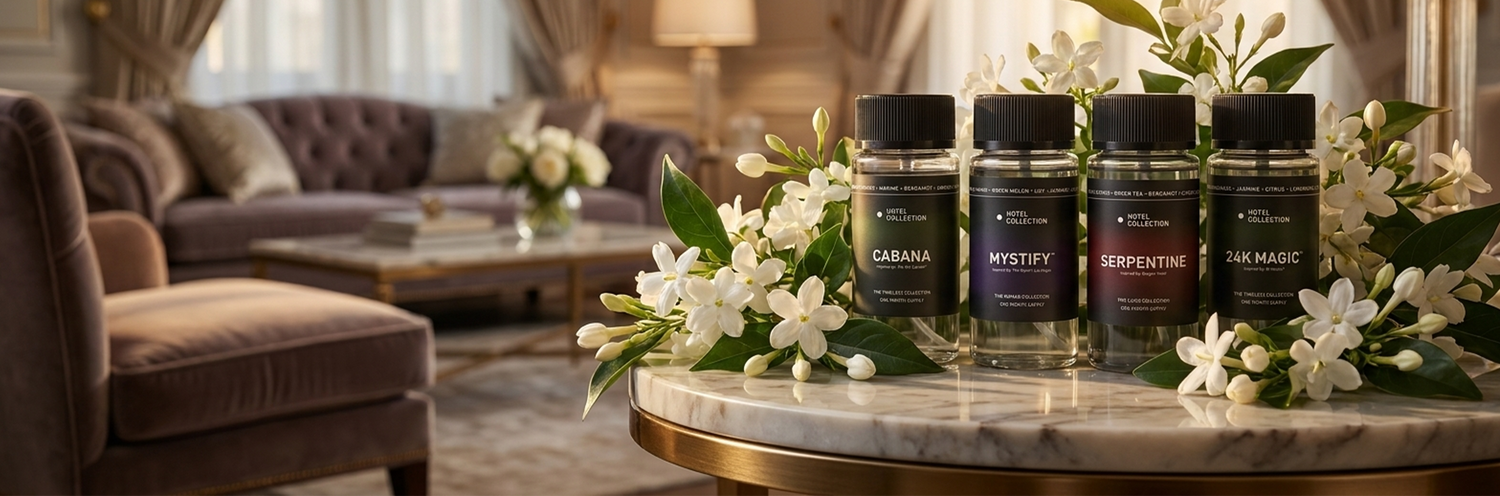
Jasmine and citrus. Bergamot, lemon, and lemongrass each bring a brightness to jasmine that lifts its heavier qualities without erasing them. The citrus acts as a clarifying lens: the jasmine beneath reads richer by contrast, while the top of the blend stays energetic and clean. 24K Magic, inspired by W Hotels, is a good example of this construction, opening with bergamot, lemon, and lemongrass before jasmine fills out the mid alongside magnolia and lily.
Jasmine and marine or green notes. Pairing jasmine with marine accords or light aquatics produces a crisp, clean result that many people associate with a fresh, resort-style atmosphere. It's a stylistic impression rather than a category rule, but the combination works well in entryways and shared spaces where you want a light but distinctive first impression. Cabana, inspired by The Ritz-Carlton, is built exactly on this pairing, with bergamot and lemon at the top, jasmine and marine in the mid, and amber and musk at the base.
Jasmine and musk or wood. Musk, sandalwood, and cedarwood ground jasmine without suppressing it. The result is warmer and deeper, and generally more suited to evening use than a citrus-jasmine blend. Sandalwood in particular has a creamy quality that mirrors jasmine's own creaminess, creating a smooth register between mid and base. Serpentine, inspired by Bvlgari Hotel, follows this structure, with jasmine petals in the mid supported by cedarwood, sandalwood, and vetiver at the base.
Jasmine and green melon or raspberry. This is a more modern, playful pairing than the others. Adding fruity green notes to jasmine brightens it in a sweeter direction, with the jasmine holding the floral center while the fruit keeps the overall blend from reading as heavy or formal. Mystify, inspired by The Wynn Las Vegas, uses this approach, pairing jasmine with green melon and lemon at the top and raspberry at the base.
The Best Jasmine-Inspired Scents from Hotel Collection
Hotel Collection's fragrance catalog includes several oils that place jasmine at or near the center of the composition. Each captures a different facet of the note: the clean citrus-jasmine of a morning lobby, the layered floral energy of a city hotel, the fresh spa-jasmine of a resort terrace, and the deep woody-jasmine of a luxury suite.
24K Magic: Layered Citrus-Floral Jasmine

Inspired by W Hotels®, 24K Magic opens with a citrus-forward brightness: bergamot, lemon, and lemongrass arrive together with energy and a slight tropical edge that distinguishes the opening from Cabana's cleaner marine start. The heart is where the fragrance earns its complexity: jasmine, lily, and magnolia form a full floral mid that is layered and warm, with koa wood and musk in the base adding depth underneath without tipping toward darkness.
The mood here is animated. Where Cabana is calm, 24K Magic has presence. It reads like a space that has been intentionally, confidently scented. Use it in rooms that should feel energized: a living area in the afternoon or an entryway that benefits from a confident first impression.
Scent profile: Layered citrus-floral with tropical accents and a musky base
Top Note - Bergamot, Lemon, Lemongrass Mid Note - Magnolia, Jasmine, Lily Base Note - Koa Wood, Musk
Available formats: Fragrance oil, Reed Diffuser, Room Spray. Shop the 24K Magic collection.
Cabana: Citrus and Marine Jasmine

Inspired by The Ritz-Carlton®, Cabana is the most luminous jasmine in this group. The opening is bergamot and lemon: clean, bright, and immediately resort-coded. As the scent settles, jasmine and marine arrive together in the mid, the floral providing warmth while the marine keeps the profile from reading as merely aquatic. The base of amber and musk gives the composition a soft warmth that holds without heaviness. For a scent that manages to feel both effortless and elevated, Cabana does it consistently.
The scent belongs to morning and midday: the living room during a weekend, a bright bathroom after a shower, any shared space where you want the air to feel like a good place to be.
Scent profile: Bright citrus-marine floral with warm amber depth
Top Note - Lemon, Bergamot Mid Note - Jasmine, Marine Base Note - Amber, Musk
Available formats: Fragrance oil, Candle, Reed Diffuser, Room Spray, Laundry Pods. Shop the Cabana collection.
Serpentine: Warm Woody Jasmine

Inspired by Bvlgari Hotel®, Serpentine is the deepest and most complex jasmine in the group. The opening of Italian bergamot, cardamom seed, and Valencia bloom gives it a spiced citrus brightness that sets expectations immediately: this is a sophisticated composition, not a simple floral. Jasmine petals alongside wild verbena and mate absolute in the mid create a layered floral-herbal accord with unusual depth, while lush geranium, crushed clove, and sheer musk in the base build a lasting warmth that develops rather than fades over time.
Serpentine belongs to evening spaces and private rooms. It has the character of a luxury suite at a genuinely exceptional hotel: considered, unhurried, and built for people who take these things seriously.
Scent profile: Spiced bergamot opening into a layered jasmine-verbena heart over warm geranium and clove
Top Note - Italian Bergamot, Cardamom Seed, Valencia Bloom Mid Note - Jasmine Petals, Wild Verbena, Mate Absolute Base Note - Lush Geranium, Crushed Clove, Sheer Musk
Available formats: Oil, Candle, Reed Diffuser, Room Spray. Shop the Serpentine collection.
Mystify: Fresh Spa Jasmine

Inspired by The Wynn®, Las Vegas, Mystify takes jasmine in its most spa-like direction. Lemon, green melon, and green tea in the top give it a fresh, herbaceous opening that immediately communicates a specific kind of luxury: clean, poolside, unhurried. Lily and jasmine in the mid keep the floral center light and transparent, while raspberry, oakmoss, and musk in the base add a quiet sweetness and depth that prevents the composition from feeling entirely surface-level.
This is a room scent for spaces that should feel like a retreat: a primary bathroom, a bedroom on a Sunday afternoon, any corner of the home where the intention is rest rather than activity.
Scent profile: Fresh herbal-floral opening with a light jasmine heart and sweet earthy base
Top Note - Lemon, Green Melon, Green Tea Mid Note - Lily, Jasmine Base Note - Raspberry, Oakmoss, Musk
Available formats: Fragrance oil, Candle, Reed Diffuser, Room Spray. Shop the Mystify collection.
Bring Jasmine Home with Hotel Collection
Jasmine performs differently depending on the space, the format, and the time of day. The right starting point is matching the scent's character to how a room actually gets used.
The bedroom rewards a deeper, more grounded jasmine. A reed diffuser near the nightstand runs continuously at a low ambient level, reading at its lightest in the morning and settling into a warmer, richer character in the evening. Serpentine, with its jasmine, cedarwood, and sandalwood construction, is well suited here, as is Mystify if you prefer something lighter and slightly fruity.
The living room benefits from a jasmine that has enough citrus and freshness to hold up in a social or active space. Cold-air diffusion is the right format: it fills a room evenly, adjusts to any intensity, and leaves no residue. Cabana and 24K Magic both work well here, with citrus-forward tops that read well throughout the day and a jasmine mid that adds warmth without weighing the space down.
The bathroom calls for something immediate and clean. A room spray in short bursts is the most practical format: no hardware, instant effect, easy to reset before guests arrive. Two or three sprays of Cabana in a tiled space creates the kind of first impression you'd expect from a well-run hotel property.
The entryway sets the tone for everything beyond it. A reed diffuser here runs continuously with no management required, and a citrus-led jasmine blend registers clearly the moment the door opens. 24K Magic works particularly well in this spot: the bergamot and lemongrass top carries across a small space, and the jasmine mid holds as people move further inside.
If you're not sure where to start, browse the full Hotel Collection fragrance collection to find the format and intensity that fits your space.
Frequently Asked Questions
Does jasmine scent smell too strong for indoor use?
Jasmine can feel intense at higher concentrations, but in home fragrance it tends to read more softly depending on the format, room size, and ventilation. Reed diffusers at normal placement release jasmine continuously at a low ambient level, and cold-air diffusers let you dial intensity up or down by setting. A good starting point is to begin low and increase gradually until the scent feels noticeable without becoming too forward.
What is the difference between jasmine and ylang-ylang?
Both are rich fragrances, florals, but they differ in character. Jasmine is often described as brighter, cleaner, and more complex, while ylang-ylang is usually sweeter, creamier, and heavier. In home fragrance, jasmine tends to be easier to live with throughout the day, while ylang-ylang is frequently used as a supporting note rather than the lead.
What is the difference between jasmine and gardenia?
Gardenia is usually described as creamy, lush, and purely floral, while jasmine carries more warmth and musky depth. Jasmine tends to hold up well in layered blends with woody or citrus partners, which can make it feel a little more versatile across different settings. In home fragrance, both work well in similar contexts and the choice often comes down to personal preference.
What is the best time of day to diffuse jasmine?
Jasmine can work throughout the day, but it may read differently depending on room temperature and format. In the morning, lighter jasmine blends can feel fresher and brighter. In the evening, warmer compositions may feel richer and more enveloping. Lighter options like Cabana and Mystify tend to work well earlier in the day, while deeper blends like Serpentine are often more rewarding in the evening, though that's more of a suggested starting point than a fixed rule.
Which Hotel Collection scent has the most prominent jasmine presence?
Of the jasmine-anchored scents in this guide, Serpentine is the most jasmine-forward option. Its warm base of cedarwood, sandalwood, and vetiver helps support the floral heart, which keeps jasmine noticeable throughout the wear. If you want a scent where jasmine is especially prominent, Serpentine is a strong place to start. Shop Serpentine.
Is jasmine fragrance oil the same as jasmine essential oil?
Not quite, and it's worth knowing the difference. True jasmine absolute is extracted directly from jasmine blossoms through solvent extraction, since the flowers are too delicate for steam distillation. It's one of the most labor-intensive raw materials in perfumery, which is why it tends to be expensive. Jasmine essential oil is a broader term that's sometimes used loosely in the market, but purists would note that a true steam-distilled jasmine oil is rare and not widely used in fine fragrance. Jasmine fragrance oils used in home scenting are typically a blend of natural and synthetic components designed to capture the character of the flower at a more accessible price point, often with better performance across diffusion formats.
What is the difference between jasminum sambac and jasminum grandiflorum?
These are the two jasmine species you'll encounter most in fragrance. Jasminum sambac, commonly known as Arabian jasmine, produces smaller, intensely fragrant blossoms and is widely cultivated across South and Southeast Asia. It's often described as sweeter, creamier, and more tropical in character. Jasminum grandiflorum, also called Spanish jasmine or common jasmine, is the variety most associated with fine perfumery and is grown in regions including Grasse, Egypt, and India. It tends to be described as richer and more opulent, with a slightly fruity sweetness that sits at the center of many classic fragrance compositions. In practice, most home fragrance blends draw on characteristics from both rather than isolating one species.
Does jasmine pair well with vanilla in home fragrance?
It can work well, though the combination leans sweet and warm, so it's worth thinking about where in your home you'd use it. Vanilla softens jasmine's animalic edge and adds a creamy richness that makes the floral feel more enveloping. The result tends to read as cozy and intimate rather than fresh or airy, which makes a vanilla-jasmine blend better suited to a bedroom or living room in the evening than to an entryway or bathroom where you might want something cleaner. If you like the direction but want more complexity, a blend that adds sandalwood or musk alongside vanilla and jasmine will feel more layered than sweet.
How does jasmine compare to rose in home fragrance?
Both are considered classic floral notes, but they behave quite differently. Rose tends to read as cooler, more velvety, and slightly powdery depending on the variety used, while jasmine is warmer, more musky, and carries that characteristic indolic depth that rose doesn't have. Rose can feel more formally floral in a home setting, while jasmine tends to feel a little more lived-in and sensual. They blend well together when the goal is a full, rich floral, with rose providing structure and jasmine adding warmth underneath. If you're deciding between the two as a primary note, jasmine is generally more versatile across citrus and woody pairings, while rose tends to work best when it's clearly the lead.
References
- Masago Y, et al. "Effects of Inhalation Aromatherapy on Symptoms of Sleep Disturbance." International Journal of Aromatherapy, 2000.